
Caorle: A seaside town with the soul of a fishing lagoon
The charming town of Caorle lies on the northern edge of the Venetian coast, approximately 75 km east of Venice and roughly 45 km west of Bibione. To the north, it is surrounded by lagoon landscape, and to the south, it opens towards the Adriatic. It is one of the most popular seaside resorts in the Veneto region, yet it still retains the character of a real town with year-round life.
Unlike purely seasonal resorts, Caorle is not a summer destination only. It functions as a living town with its own history, inhabitants, traditions and everyday rhythm, which continues even outside the primary tourist season.


Historic center
The history of Caorle dates back to ancient times, when the town served as an important port and trading point connecting the hinterland with the lagoon and the sea. In the Middle Ages, it became part of the Venetian Republic, and its development was closely linked to seafaring, fishing, and coastal protection for centuries.
The historic centre has preserved its original character to this day. Narrow alleys, low houses and small squares form a whole that does not feel ostentatious or artificial. The colourful houses, so popular in photographs today, are rooted in the practical needs of the past and naturally fit into the town’s overall image.
The dominant feature of the historic centre is the Duomo di Santo Stefano, with its characteristic cylindrical Romanesque bell tower, visible from afar and a prominent landmark.


Scogliera Viva promenade
The coastline of Caorle is clearly divided into eastern and western parts. On the east side lies Levante Beach, approximately 2.7 km long, which extends from the historic centre toward the lagoon and the Falconera area. On the western side follows Ponente beach, about 1.8 km long, heading towards the mouth of the Livenza River and Porto Santa Margherita.
The two parts are connected by the coastal promenade Scogliera Viva, a raised stone path that follows the shoreline. It is lined with sculptures by contemporary artists and connects naturally to the town’s recreational areas. It is essentially an open-air gallery that ends at Madonna dell’Angelo, one of Caorle’s most distinctive buildings, with an iconic presence.
Madonna dell’Angelo: A church on the edge of town and sea
The church of Madonna dell’Angelo stands on one of the town’s oldest spiritual places. The current building dates to 1751 and follows an earlier sacred structure that stood here as early as the Middle Ages and was initially dedicated to the Archangel Michael.
Its location on the very edge of the mainland was no coincidence. For centuries, it served as a landmark for sailors and fishermen, and as a place of protection and prayer before setting out to sea.
The church is also associated with a legend about a wooden statue of the Madonna with child, which was found at sea and, according to tradition, repeatedly returned to this very place. The story underscored the shrine’s importance and its place in the local spiritual tradition.
Today, Madonna dell’Angelo serves as a peaceful transition between town and sea – a place with expansive views where history and landscape meet naturally.

Harbour and gastronomy
The harbour in Caorle is not just a tourist facility, but still fulfils its original function. In the morning, fishing boats arrive here, and their catches appear in local restaurants and osterias.
Local cuisine is rooted in the traditions of the northern Adriatic and relies primarily on fresh fish and simple preparation. Typical dishes include polenta-based dishes, fish soups, sardines in saor (sweet-and-sour), and eel prepared according to traditional recipes. Pasta with clams or seafood, and light risottos, are also standard offerings.
Beaches
The beaches in the Caorle area form a continuous strip of fine golden sand with a gently sloping entrance to the sea. Within the town, the coastline is divided into two main parts: Levante and Ponente.

Levante beach stretches towards the lagoon and has a more open, calmer feel. Ponente beach adjoins the town centre and leads towards the Livenza River. Both are well-equipped, clearly laid out, and suitable for families with children.
The town beaches transition into Lido Altanea, a modern area with more greenery, cycle paths and recreational facilities. Further along the coast, Porto Santa Margherita features a harbour and residential buildings, followed by Duna Verde, which is characterised by expansive beaches, a dune belt, and a pine grove.
While the beaches in Caorle itself are connected with urban life, the surrounding areas feel calmer and more natural. They offer more space and less noise, which is especially appreciated by those looking for relaxation away from the main tourist centres.
In the immediate vicinity of the town, on the road towards Duna Verde, there is also the Aquafollie water park, one of the best-known in the area and a popular facility especially for families with children during the summer months.
The atmosphere outside the summer season
Caorle is a year-round town. Although tourist activity calms down significantly in the winter months, the city does not lose its functionality or character.
Unlike purely seasonal resorts such as Duna Verde or Eraclea Mare, where life almost comes to a halt after summer, Caorle remains active year-round. In this respect, it is more similar to towns such as Lido di Venezia or Chioggia.
Autumn and winter reveal a calmer face of the town. It is ideal for walks along the sea, exploring the historic centre, and observing residents’ everyday life. It is precisely in this period that one can perceive the true character of Caorle.


The surroundings of Caorle: Lagoon, casoni and fishing landscape
The town’s immediate surroundings consist of extensive lagoon landscapes that have shaped local inhabitants’ way of life for centuries. Inland, the coastline turns into a network of waterways, wetlands and fishing areas.
A typical feature of this landscape is the casoni, traditional fishermen’s huts built from reeds, wood and clay. They served as seasonal dwellings for fishermen who spent long weeks here. Their simple architecture was fully adapted to local conditions and the natural rhythm.
When looking at the lagoon and the traditional casoni today, we often tend to view this world through a romantic lens – as a quiet landscape connected to nature and a simple way of life. The reality, however, was far more demanding. The life of fishermen was physically challenging and entirely dependent on the weather, the seasons and the changing sea. The casoni served only as basic shelters, offering no comfort and exposing their inhabitants to wind, humidity and isolation. Only when encountering this landscape in person does one fully realise how harsh the conditions were here for many years.
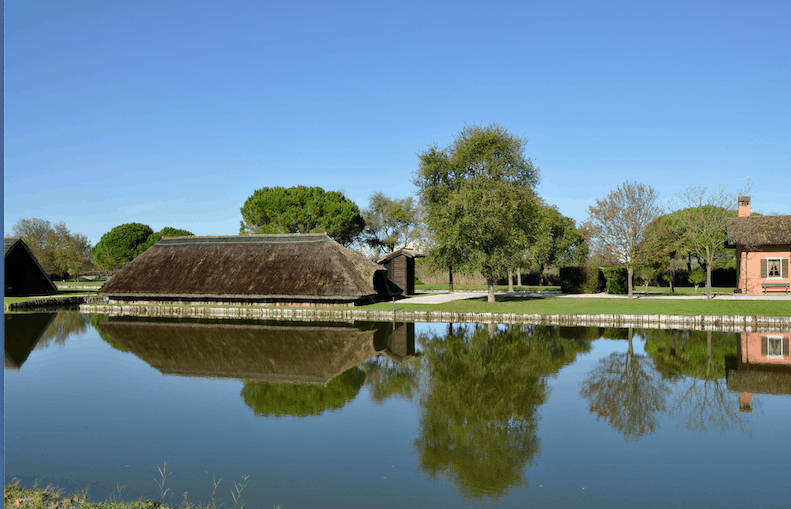
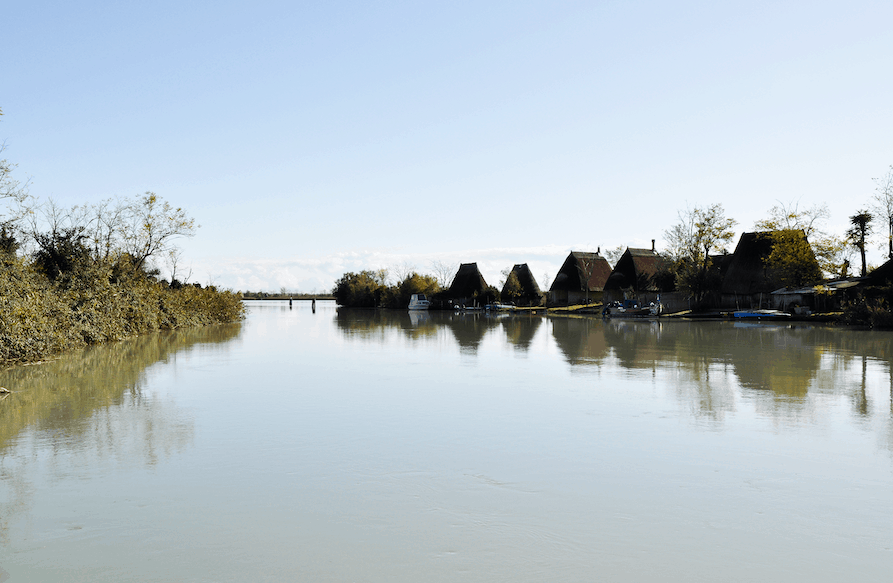
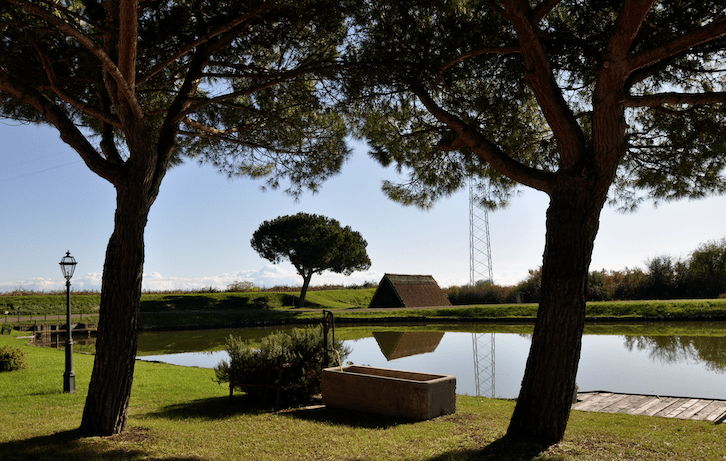
The lagoon near Caorle, along with the areas of Falconera, Vallevecchia, and Brussa, forms an open, quiet landscape with minimal development. The location is now accessible on foot, by bike and also via seasonal boat transport, which makes it possible to combine a cycling trip with a boat ride, a typical way of exploring this part of the Veneto.
The lagoon around Caorle retains an extraordinary calm that, in the past, attracted artists and writers as well. Ernest Hemingway found inspiration here for his novel Across the River and into the Trees.
Transport accessibility
Caorle is easily accessible without a car. You can get here by bus or by train with connections from Venice or Treviso. After arrival, the most important places are accessible on foot or by bike.
Nearby locations such as Porto Santa Margherita or Duna Verde are connected by local transport and a network of cycle paths that run along the coast.
Accommodation
Accommodation in Caorle reflects the area’s diversity and offers options for a range of visitors, from urban stays to peaceful seaside holidays. This contrast is typical for Caorle.
For those who want to be in the centre
Within the town, there are hotels and apartments integrated into Caorle’s historic architecture. They are ideal for visitors who like an urban atmosphere.
For families and longer stays
In the surrounding areas, campsites, holiday resorts, and vacation complexes predominate, often with facilities for motorhomes. They are particularly suitable for families with children and for those seeking more space and the option of more extended stays.
For a peaceful stay by the port
Porto Santa Margherita has a more residential character and its own harbour. It is suitable for visitors who want to be by the sea but away from the main bustle of campsites and the centre.
For peace and nature
The Duna Verde resort is considered one of the greenest in Italy, thanks to extensive pine forests that separate the beaches from residential areas and to well-preserved dunes that form a natural barrier.
Approximate distances
- Venice (Venezia): approx. 75 km
- Udine: approx. 80 km
- Trieste: approx. 115 km
Nearest airports:
- Venice Marco Polo (VCE) – approx. 55 km
- Treviso (TSF) – approx. 70 km
Most key places in Caorle are accessible on foot or by bike. The surrounding areas are also easily accessible by bus. Timetables with a clear map are available here.
In conclusion
Caorle is a town with its own rhythm, history and character, shaped over centuries on the boundary between sea and lagoon. It combines the atmosphere of the Venetian coast, the fishing tradition, the natural beauty of the surrounding landscape, and the calm pace of a year-round town.
It is precisely this balance that makes Caorle an exceptional place. On the one hand, it offers long, sandy beaches, high-quality holiday facilities, and plenty of leisure opportunities; on the other, it retains the authentic character of a town where residents, fishermen, and visitors seeking a calmer side of the Adriatic still meet.
Whether one comes here for the sea, history, gastronomy or simply for a slower pace of life, Caorle can offer more than just a stay by the water. Its charm lies in the subtle balance between town, sea and lagoon, which gives this place a unique, almost magical atmosphere. It is precisely this combination that gives Caorle its character.
Veneto Info Magazine